

If you’re reading this because you’ve noticed your toddler isn’t making eye contact the way other children do, or because a pediatrician just suggested developmental screening, you’re likely feeling overwhelmed and afraid. Those feelings are valid. The good news: you’re already doing the most important thing a parent can do (seeking information and taking action).
Early intervention for autism means starting evidence-based therapies like ABA, speech, and occupational therapy as early as possible, ideally before age three. Research shows that intensive, individualized therapy during the critical early-learning window significantly improves communication, social, and daily-living skills. In Arizona, families can access early intervention services for autism through state programs like the Arizona Early Intervention Program (AzEIP) and private ABA clinics, often before a formal autism diagnosis is in place.
This guide walks you through what early intervention really means, why the first three years matter, how to recognize the signs that warrant action, and exactly where to start in Arizona. You’ll learn what a typical week looks like, how to choose a provider, and what realistic progress looks like. Most importantly, you’ll walk away knowing the first three steps to take today.
What Is Early Intervention for Autism?
Early intervention is a coordinated system of services designed to support infants and toddlers (birth to age three) who show developmental delays or disabilities. For children on the autism spectrum or showing early signs, early childhood intervention in Arizona typically includes Applied Behavior Analysis (ABA) therapy, speech therapy, occupational therapy, and parent training delivered in the child’s natural learning environments.
The defining feature is timing. Brain development is most rapid and flexible during the first three years of life. Neural pathways that support communication, social interaction, motor skills, and emotional regulation are forming at an extraordinary rate. The brain’s capacity to form and strengthen new connections peaks during this window.
Think of it this way: a toddler’s brain is like wet clay (responsive, shapeable, ready to take form). By age three, that clay begins to harden. Skills that might take six months to build at age two could take years to develop if intervention starts at age five. This doesn’t mean older children can’t make progress (they absolutely can), but the effort required increases significantly as the window narrows.
ABA therapy is the most researched and evidence-supported intervention for autism. It breaks down complex skills (making eye contact, requesting a toy, taking turns) into small, teachable steps and uses positive reinforcement to help children learn. Every child can learn when teaching is individualized, consistent, and started early enough.
Speech therapy addresses communication delays, helping nonverbal children develop functional communication (through words, signs, or picture systems) and helping verbal children expand language. Occupational therapy focuses on sensory processing, fine motor skills, and daily-living activities like eating, dressing, and play. These therapies often overlap and complement each other, which is why the best early intervention programs coordinate all three under one individualized treatment plan.
Early intervention is not a cure for autism. It’s a systematic way to build the skills every child needs to communicate, connect, and navigate daily life. It meets children where they are and helps them progress toward meaningful goals their families care about. The earlier it starts, the more foundational those skills become.
Why Starting Early Matters: The Research Behind the Window
The urgency around early intervention isn’t marketing hype. It’s grounded in decades of neuroscience and outcome research showing that the brain’s capacity for change peaks in the first three years and declines steadily afterward. During this period, the brain forms more than one million new neural connections every second. Experiences during these years literally shape the architecture of the developing brain.
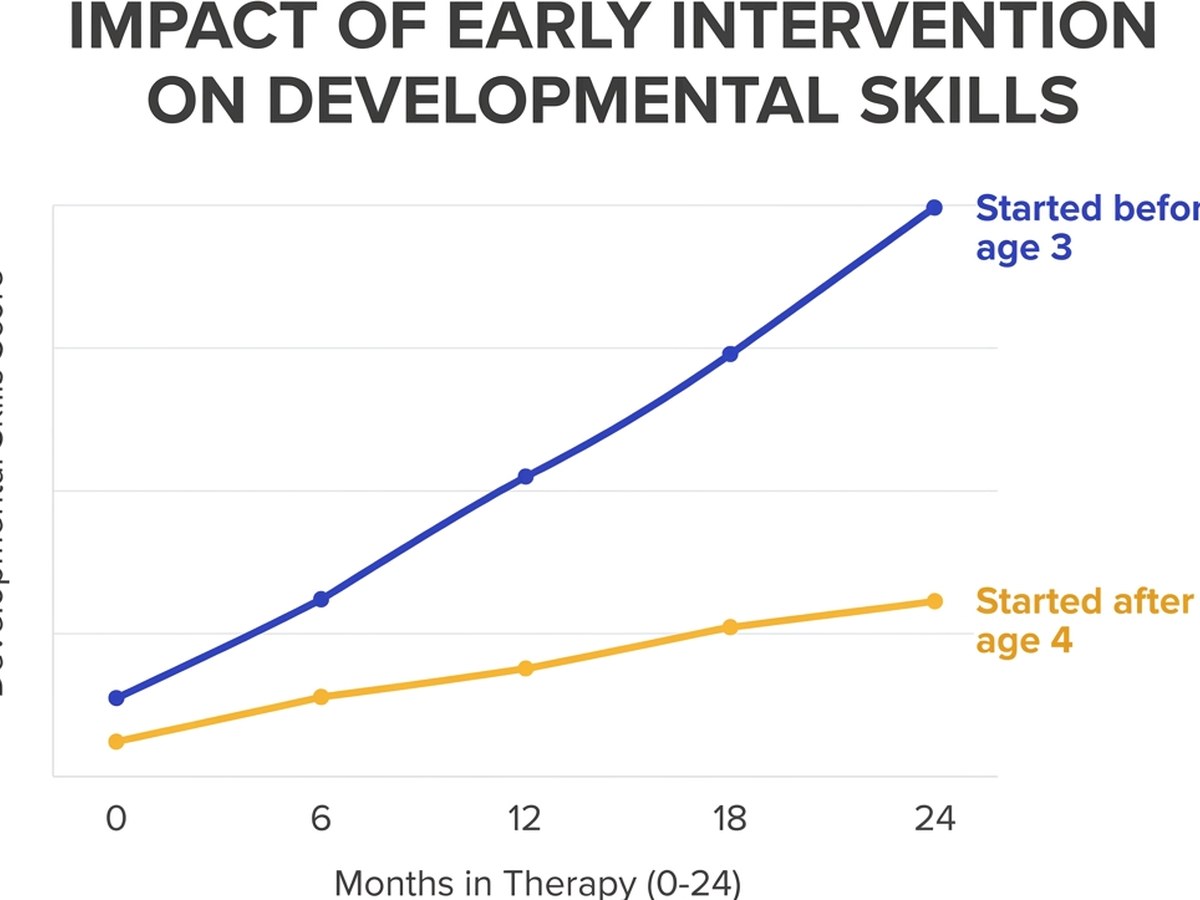
Research confirms that brain plasticity is highest before age three, making this the most critical window for skill acquisition in children with autism. Children who receive intensive early intervention programs during this period show significantly greater gains in IQ, language, adaptive behavior, and social functioning compared to children who start later. The magnitude of improvement is directly correlated with how early therapy began and how many hours per week the child received.
In our work with families across Arizona, we see similar patterns. Children who start ABA therapy before age three often show their first communication breakthroughs within the first six to eight weeks of consistent therapy: a pointed finger to request a snack, a spontaneous wave goodbye, the ability to sit and attend during a five-minute activity. These small wins compound quickly when the brain is primed to learn.
Does this mean it’s too late if your child is four, or five, or older? Absolutely not. Older children make meaningful progress every day in quality ABA programs. But the research is unambiguous: earlier is better. The skills a three-year-old can acquire in six months might take a six-year-old 18 months to build. Starting early doesn’t guarantee a specific outcome, but it maximizes your child’s potential to build the communication and social foundation that everything else rests on.
If you’re feeling guilt about not recognizing signs sooner, or anger that a pediatrician told you to “wait and see,” let that go. You’re here now. You’re taking action. That’s what matters. Many families face delays in accessing autism services due to long waitlists, insurance barriers, and provider shortages (especially in rural areas). The fact that you’re seeking information and starting the intake process means you’re already ahead of the curve.
Recognizing the Early Signs: When to Act
One of the most paralyzing questions parents face is: “Are these delays normal, or is this something more?” Toddlers develop at wildly different rates. The variability is real, and it makes it hard to know when concern is warranted.
Here’s the guiding principle: trust your instinct, and act on patterns rather than isolated moments. If you’re noticing multiple red flags persisting over weeks or months, that’s your signal to seek a developmental screening. You don’t need to be certain your child has autism to pursue evaluation. Early intervention services for autism are available for any child showing developmental delays, whether or not autism is the underlying cause.
The Centers for Disease Control and Prevention recommend developmental screening at regular well-child visits, with autism-specific screening using tools like the Modified Checklist for Autism in Toddlers (M-CHAT-R/F). The M-CHAT is a simple parent questionnaire that flags potential concerns. If your child screens positive, the next step is a comprehensive diagnostic evaluation. Screening itself takes less than five minutes and can be done during a regular pediatric visit.
Here are the early signs that warrant action:
By 12 months:
- No babbling or cooing
- No back-and-forth gestures like pointing, reaching, or waving
- Limited or no eye contact during play or feeding
- No response to their name being called
By 16 months:
- No single words (even approximations like “ba” for ball or “da” for dad)
- Extreme distress with changes in routine
- Intense focus on parts of toys (spinning wheels, lining up objects) rather than functional play
By 24 months:
- No two-word phrases (“more milk,” “want up”)
- Loss of previously acquired language or social skills (regression is a significant red flag)
- Lack of pretend play (feeding a doll, pretending a block is a car)
- Repetitive movements like hand-flapping, rocking, or toe-walking
- Difficulty transitioning between activities or extreme meltdowns over minor changes
If your child shows several of these signs, the next step is not to panic. It’s to schedule a developmental screening with your pediatrician or contact Arizona’s early intervention system directly. Many pediatricians still use a “wait and see” approach, advising parents to give it a few more months. That advice is outdated. There is no harm in early screening and enormous potential harm in delaying evaluation when concerns are present.
You know your child better than anyone. If something feels off (if your gut says “this isn’t just shyness” or “other kids his age are doing things he isn’t”), trust that instinct. Parents are right far more often than they’re wrong.
Do You Need a Diagnosis to Start?
This is one of the most common questions parents ask, and the answer depends on the service pathway you’re pursuing. The short answer: no, you do not always need a formal autism diagnosis to access early intervention services. The longer answer requires understanding two parallel systems in Arizona.
Arizona Early Intervention Program (AzEIP) serves children birth to age three who have a developmental delay or a diagnosed condition likely to result in delay. Eligibility is based on developmental testing. If your child scores significantly below age level in one or more areas (communication, motor skills, social-emotional development), they qualify for AzEIP services. An autism diagnosis is not required. Many children receive speech therapy, occupational therapy, and developmental support through AzEIP while a diagnostic evaluation is still pending. This is especially valuable because diagnostic wait times in Arizona can stretch from three to nine months depending on your location.
Insurance-funded ABA therapy at private clinics typically does require an autism spectrum disorder diagnosis. Most commercial insurance plans and Arizona’s Medicaid program (AHCCCS) cover ABA therapy when a licensed psychologist or developmental pediatrician has issued a formal diagnosis. The diagnostic process includes developmental history, direct observation, standardized testing (like the ADOS-2), and clinical judgment.
Here’s the practical timeline most Arizona families experience:
- Concern arises (parent or pediatrician notices delays): Week 0
- Developmental screening (M-CHAT or similar): Week 1-2
- Referral for diagnostic evaluation: Week 2-4
- Diagnostic appointment scheduled (waitlist varies: 4-24 weeks depending on provider)
- AzEIP intake begins in parallel (doesn’t wait for diagnosis): Week 3-6
- Diagnosis received: Month 2-6
- Insurance authorization for ABA therapy: Month 3-7
- ABA therapy begins: Month 3-7
The key insight: you can start building support while waiting for a formal diagnosis. AzEIP services can begin within weeks. Many families also pursue private developmental screenings so that the moment a diagnosis is confirmed, insurance authorization and therapy can start immediately.
At Arizona Autism Clinic, we begin the intake process as soon as a family reaches out. If you’re waiting on a diagnostic evaluation, we complete our internal screening and insurance verification so that when the diagnosis arrives, your child can start therapy within days rather than months. We’ve seen too many families lose critical months sitting on waitlists after receiving a diagnosis. Our goal is to eliminate that gap.
If you’re unsure whether to pursue evaluation, here’s the guideline: if you’ve noticed multiple red-flag behaviors persisting for more than a month, call your pediatrician and request a referral for developmental evaluation. Do not wait for the 18-month or 24-month well-child visit if concerns are present earlier.
How to Access Early Intervention Services in Arizona
Arizona families have two primary pathways to access early childhood intervention in Arizona: the state-funded Arizona Early Intervention Program (AzEIP) for children birth to three, and private ABA therapy clinics that accept insurance. Many families use both systems simultaneously or transition from AzEIP to private ABA therapy as their child approaches age three.
Arizona Early Intervention Program (AzEIP)
AzEIP is Arizona’s early intervention system for infants and toddlers with developmental delays or disabilities. Services are provided at no cost to families, regardless of income.
Eligibility: Your child qualifies for AzEIP if they have significant developmental delays in one or more areas (communication, motor, social-emotional, cognitive, or adaptive) or a diagnosed condition likely to cause delay (including autism). Eligibility is determined through a free developmental evaluation conducted by an AzEIP team.
Services offered: AzEIP provides speech therapy, occupational therapy, physical therapy, developmental specialists, and family coaching. Services are delivered in your home, at childcare, or in other natural settings. The program is family-centered, meaning you’re an active participant in every session.
How to access: You can make a referral yourself (you don’t need a doctor’s referral). Call Arizona’s AzEIP intake line or visit the state’s Department of Economic Security website to start the process. An AzEIP coordinator will schedule an initial evaluation within 45 days. If your child qualifies, an Individualized Family Service Plan (IFSP) is developed outlining goals and services.
Limitations: AzEIP is not an ABA program. While it provides valuable developmental support, it does not offer the intensive, one-to-one early intervention autism therapy that research shows is most effective for autism-specific skill-building. Most AzEIP services are delivered weekly or bi-weekly, whereas early intensive ABA therapy often involves 10 to 25 hours per week.
Private ABA Therapy Clinics
Private ABA clinics like Arizona Autism Clinic specialize in autism-specific intervention. Services are typically covered by commercial insurance or Arizona Medicaid (AHCCCS) once a formal autism diagnosis is in place.
How it works: After an autism diagnosis, your child’s doctor submits a referral and treatment recommendation to your insurance. The ABA clinic (working with your family) submits an authorization request detailing the proposed therapy hours and goals. Most Arizona insurance plans cover ABA therapy as an essential health benefit.
Once authorized, a Board Certified Behavior Analyst (BCBA) conducts a comprehensive assessment of your child’s skills and designs an individualized treatment plan. Therapy is delivered by a Registered Behavior Technician (RBT): a trained paraprofessional who works one-to-one with your child under the BCBA’s supervision. Sessions typically occur three to five days per week, each lasting two to four hours.
What makes Arizona Autism Clinic different: We practice True 1:1 technician-to-client pairing, meaning your child has one dedicated RBT’s full attention for the entire session (never shared, never split). Many ABA providers use a shared-technician model where one RBT rotates between multiple children. That approach dilutes attention and disrupts the consistency young children need.
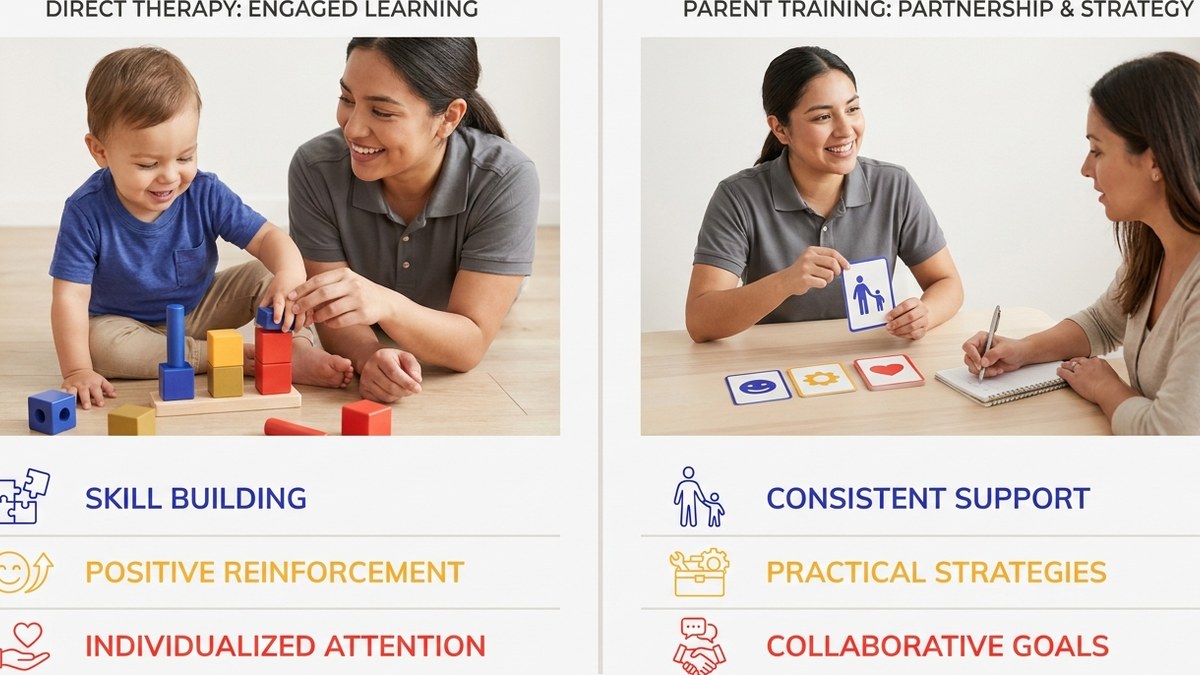
We also embed parent coaching into every session. At the end of each visit, the RBT walks you through what your child worked on, what strategies were effective, and how to practice those skills at home. You’re not a spectator; you’re a partner. Research consistently shows that parent involvement accelerates progress and helps skills generalize beyond the therapy room.
We serve families in Mesa, Apache Junction, Gilbert, and the East Valley, with clinic locations in Apache Junction and Lakeside-Pinetop. Our Lakeside-Pinetop location ensures that families in the White Mountains (where many national providers don’t reach) have access to the same high-quality, evidence-based care available in metro Phoenix.
Starting the process: Contact Arizona Autism Clinic as soon as you receive an autism diagnosis or even earlier if you’re in the evaluation process. We’ll verify your insurance benefits, walk you through what’s covered, and begin the intake paperwork. Once authorization is approved (usually within two to four weeks), we schedule your child’s BCBA assessment and first therapy session.
What Early Intervention Looks Like: A Week in the Life
If you’ve never seen ABA therapy in action, it’s natural to feel uncertain about what your child will actually be doing for 10 or 15 or 20 hours a week. Here’s what a typical week of early intervention at Arizona Autism Clinic looks like for a two-and-a-half-year-old named Liam (details changed to protect privacy, but the structure is real).
Monday, 9:00-11:30 a.m.: Liam’s RBT, Sarah, arrives at the family’s home. The session starts with his favorite activity: building with large foam blocks. Sarah follows Liam’s lead, narrating his play (“You’re stacking! Big tower!”) and waiting for him to make eye contact or gesture before handing him the next block. This isn’t random play. It’s structured to increase Liam’s social initiation and joint attention. After 20 minutes, Sarah introduces a new goal: requesting using a picture card. Liam wants his stuffed dog, which Sarah holds out of reach. She prompts him to hand her the picture of a dog, then immediately gives him the toy and celebrates (“Great asking, Liam!”). They repeat this sequence with different toys five times. Sarah spends the last 10 minutes with Liam’s mom, showing her how to use the same picture-card system when Liam wants a snack or a book.
Wednesday, 1:00-3:30 p.m.: Today’s session focuses on reducing Liam’s meltdowns during transitions. Liam struggles when playtime ends and it’s time to clean up or eat lunch. Sarah uses a visual timer and a “first-then” board (First: clean up. Then: snack). She sets the timer for five minutes and works on a puzzle with Liam. When the timer rings, she shows him the board and helps him put three puzzle pieces in the basket. The moment he complies, she delivers the promised snack immediately (reinforcing that following the direction leads to something good). They practice this sequence three times during the session with different activities. Sarah takes data on every trial: how long he took to comply, whether he needed a physical prompt, whether he cried. This data goes into the BCBA’s tracking system and informs adjustments to the plan.
Friday, 9:00-11:30 a.m.: This session introduces a new goal: imitation. The BCBA identified that Liam rarely imitates actions (clapping, waving, patting head), which is a foundational skill for learning. Sarah sits across from Liam with a basket of toys. She claps her hands, says “do this,” and waits. Liam doesn’t respond, so Sarah gently guides his hands to clap, then immediately praises him and gives him a toy he loves. After several trials with full prompting, Liam starts clapping on his own when Sarah models it. This is a breakthrough.
What the parents do: Liam’s mom observes most sessions and practices the strategies Sarah demonstrates. She’s learned to use the picture cards when Liam wants something, to narrate his play to encourage language, and to stay calm during meltdowns. Liam’s dad joins the Friday debrief and asks Sarah how to handle bedtime refusal using the same “first-then” approach. Sarah coaches him through it. This is why parent coaching is non-negotiable in quality early intervention: skills learned in therapy mean nothing if they don’t transfer to daily life.
What the BCBA does: Every two weeks, Liam’s BCBA reviews Sarah’s data, observes a live session, and adjusts goals. If Liam masters a skill (like requesting with picture cards), the BCBA advances the goal (maybe to verbal approximations instead of pictures). If progress stalls, the BCBA troubleshoots. The BCBA also meets with Liam’s parents monthly to review progress graphs, celebrate wins, and adjust priorities based on what the family cares about most.
This is what early intervention looks like: structured, individualized, data-driven, and relentlessly focused on the skills that unlock communication, play, and connection.
Choosing the Right Early Intervention Provider
Not all early intervention programs are created equal. The provider you choose will shape your child’s trajectory and your family’s experience over the next several years. Here’s what to look for.
Non-Negotiable Criteria
1. Board Certified Behavior Analyst (BCBA) oversight: Every ABA program must be designed and supervised by a BCBA. A BCBA has completed graduate-level coursework in behavior analysis, thousands of supervised fieldwork hours, and passed a rigorous national exam. Ask any provider: “Will my child’s program be designed by a BCBA? How often does the BCBA observe my child’s sessions?” If the answer is vague or the BCBA’s involvement is minimal, walk away.
2. True 1:1 staffing ratio: Your child should have one technician’s undivided attention for the entire session. Some clinics practice “1:2” or “1:3” staffing: one RBT working with two or three children at once. That’s not early intervention. Young children with autism need intensive, individualized teaching. Arizona Autism Clinic guarantees True 1:1 pairing: one RBT per child, every session, no exceptions.
3. Family involvement is required, not optional: You should be observing sessions, asking questions, learning strategies, and practicing skills with your child at home. If a provider says “just drop your child off and we’ll handle it,” that’s a red flag. At Arizona Autism Clinic, parent coaching is embedded into every session because we know skills only matter if they generalize beyond the therapy room.
4. Data-driven progress tracking: Every session should generate data. How many times did your child request independently? How long did they attend to an activity? Did they meet the goal, or do we need to adjust? This data should be shared with you regularly. Ask providers: “How will I see my child’s progress? Will I get graphs, reports, or session summaries?”
5. Insurance transparency: The provider should verify your benefits before you commit, explain what’s covered and what’s not, and handle authorization paperwork. Arizona Autism Clinic verifies insurance during intake and walks families through the entire authorization process so there are no surprises.
Before you commit to any provider, ask these questions (we share a full list in our guide on how to choose an ABA provider):
- What’s your staff-to-child ratio during sessions?
- How often will the BCBA observe my child?
- How do you involve parents in the therapy process?
- Can I observe sessions? Can I ask questions during or after?
- What does your progress reporting look like?
- How do you handle insurance authorization and billing?
Trust your gut. If a provider feels impersonal, if they rush you through intake, if they can’t answer basic questions about their model, keep looking. Early intervention is too important to settle for “good enough.”
What Families Can Expect: Milestones, Progress, and Patience
Let’s be honest about what early intervention can and cannot do. It is not a cure for autism. It will not make your child “normal” (a term we reject because every child’s neurology is valid as it is). What it will do (if started early, delivered consistently, and tailored to your child’s unique needs) is build the communication, social, and daily-living skills that open doors your child couldn’t walk through before.
Progress in early intervention is rarely linear. You’ll have weeks where your child learns three new words and starts making eye contact during meals, followed by weeks where they regress because they’re teething, or sick, or adjusting to a new environment. This is normal. What matters is the overall trend over months, not the day-to-day fluctuations.
Here are realistic milestones families often see in the first six to twelve months of early intensive ABA therapy (starting before age three):
Communication gains:
- First functional words or word approximations
- Use of gestures to request or protest (pointing, reaching, pushing away)
- Increased vocalizations or babbling
- Ability to request preferred items using pictures, signs, or words
- Responding to their name more consistently
Social engagement:
- More frequent eye contact, especially during play or when requesting
- Beginning to notice and show interest in peers
- Tolerating parallel play (playing near another child without distress)
- Responding to simple social games (peek-a-boo, chase)
Daily-living skills:
- Sitting at the table for meals for longer periods
- Tolerating tooth-brushing or hair-washing with less resistance
- Following one-step instructions (“come here,” “sit down”) with minimal prompting
- Transitioning between activities with fewer meltdowns when visual supports are used
Behavioral regulation:
- Shorter, less intense tantrums (even if they still happen)
- Ability to wait a few seconds for a preferred item when asked
- Beginning to use alternative communication (picture cards, signs) instead of screaming or hitting to get needs met
These are foundational skills. They might not sound dramatic, but they change everything. A child who can request a snack instead of melting down has gained autonomy. A child who can tolerate a haircut without screaming has reduced family stress. A child who makes eye contact during play has opened the door to connection. These are the wins you’ll celebrate, and they matter more than any standardized test score.
Some children make rapid, sweeping gains in the first few months. Others progress more slowly. There is no single timeline because every child’s neurology, history, and starting point are different. What research on early intervention outcomes shows (and what we see every day) is that consistent, high-quality early intervention produces meaningful progress over time. The key word is consistent.
There will be hard days. Days when you wonder if it’s working, if you made the right choice, if you should try something else. That’s normal. On those days, look back at where you started. Watch a video from your child’s first therapy session and compare it to today. The progress might be subtle, but it’s there.
If you’re wondering what happens as your child grows, know that ABA therapy isn’t just for toddlers. Many children continue benefiting from ABA therapy through their teen years and into young adulthood, especially when programs evolve to address age-appropriate goals like independent living, vocational skills, and community participation. Early intervention is the foundation, but it’s not the finish line.
Taking the First Step: You’re Not Alone in This
If you’ve read this far, you’re no longer paralyzed by fear or uncertainty. You understand what early intervention is, why the first three years matter, how to access services in Arizona, and what to look for in a provider. You know the signs to watch for, the questions to ask, and the realistic outcomes to expect. Most importantly, you know that acting now (today) is the most powerful thing you can do for your child.
Early intervention is not a guarantee of a specific future. It’s an investment in your child’s capacity to learn, communicate, and connect. It’s the decision to meet your child where they are and help them build the skills they need to thrive. The earlier you start, the more time you give your child to grow. The window is real, but it’s not closed yet.
The first step is simple: reach out. Schedule a developmental screening with your pediatrician. Contact AzEIP to begin a free evaluation. Call Arizona Autism Clinic to start the intake process and verify your insurance. Don’t wait for the next well-child visit. Don’t wait for more certainty. If you’ve noticed the signs, if your gut says something is off, act. The best time to start was three months ago. The second-best time is today.
You’re doing this because you love your child and you refuse to accept that “wait and see” is good enough. That courage is everything. The families who make the most progress are not the ones with the perfect diagnosis or the ideal circumstances. They’re the ones who start early, stay consistent, and trust the process even when it’s hard. You’re already in that group.
Families navigating this journey are not alone. Federal coordination of autism research and services continues to expand understanding and access to evidence-based support. Many parents also find that understanding co-occurring mental health needs helps them advocate more effectively for comprehensive care as their child grows.
At Arizona Autism Clinic, we’ve walked this road with hundreds of Arizona families. We know the fear you’re feeling. We know the hope you’re holding. We know what it takes to build a program that honors your child’s individuality and equips them with the skills they need to reach their full potential. We’d be honored to walk this road with you.
We’ll walk you through screening, insurance verification, and building your child’s personalized treatment plan. You’re not alone in this. Every journey starts with a single step. Take yours today.